
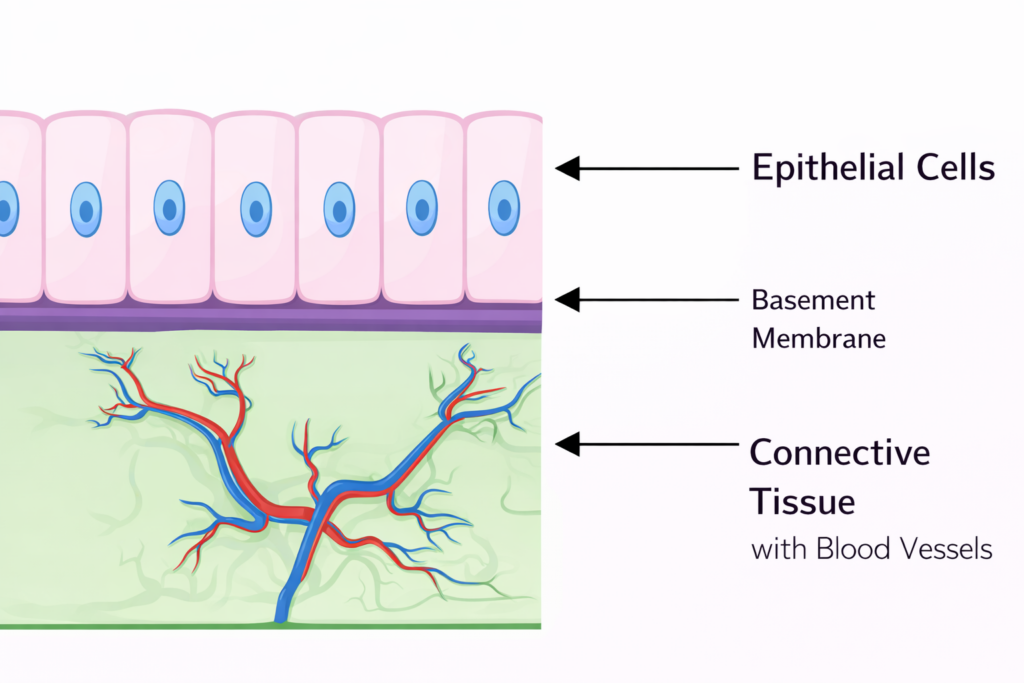
Epithelial cells form a cell layer on the basement membrane; beneath them lies connective tissue with blood vessels for its supply.
Medical Foundations

Tissue Types Explained Simply: From Cells to Organs and Organ Systems

I understand the body best when I build it up from the smallest to the largest. First, I look at cells. Then I show how tissue types develop from them and why their structure matters. I also explain how several tissues form an organ and how organ systems work together. This way, you’ll understand what epithelium protects, connective tissue supports, muscle moves, and nerve tissue controls. Additionally, I clearly distinguish between parenchyma and stroma so you can classify their functions. This helps you learn terms faster.

Eukaryotic cell illustration labeled with nucleus, nuclear membrane (nucleolemma), cytoplasm, and cell membrane (plasmalemma).
Medical Foundations

The Human Cell: How Your Body’s Smallest Building Block Works

The human cell is my starting point when I truly want to understand the body. Because every function begins on a small scale. I’ll show you how the human cell absorbs substances, uses energy, and processes signals. You’ll also learn about the basic structure: the cell membrane, nucleus, and cytoplasm. This will help you understand more quickly why tissues and organs function the way they do. I deliberately keep things simple. Nevertheless, I’ll give you examples and a short checklist for everyday use.

Scroll to Top
Cookie Consent Banner by Real Cookie Banner