

The human cell is my starting point when I truly want to understand the body. Because every function begins on a small scale. I’ll show you how the human cell absorbs substances, uses energy, and processes signals. You’ll also learn about the basic structure: the cell membrane, nucleus, and cytoplasm. This will help you understand more quickly why tissues and organs function the way they do. I deliberately keep things simple. Nevertheless, I’ll give you examples and a short checklist for everyday use.
1. The Smallest Unit
I understand the human body best when I start at the very basic level. That’s why I begin with the cell. Because every movement, every thought, and every healing process begins there. Furthermore, organs don’t simply appear out of thin air. They are composed of many small building blocks. These building blocks are precisely what makes the difference.
Many people first think of skin, muscles, or bones. This makes sense because you can see or feel them. However, the real logic lies beneath the surface. If I want to know why an organ functions, I look at the cells. This is where the processes take place that later become visible as performance.
In this article, I’ll guide you step by step through the basics. First, I’ll explain what a cell actually is. Then, I’ll show the difference between single-celled and multicellular organisms. Next, I’ll categorize sizes and numbers. And then I’ll move on to specific cell types in the body. This way, I build a clear foundation. That’s why the rest will be easier later on.
2. What is a Cell? The Smallest “Life Factory”
A cell is the smallest unit that actively organizes life. I like to call it a “life factory”. It works independently. It takes in substances. It processes these substances. And it releases waste. It can also grow. And it can divide when the conditions are right.
It’s important to note: I’m not talking about a tiny component without a function. I’m talking about a complete system in miniature. A cell regulates energy, transport, structure, and communication. That’s why I can use it as the basis for everything else.
2.1 Cell, Tissue, Organ: How Everything Is Connected
I imagine the body as a team of specialists. A single cell can do a lot. Nevertheless, it only achieves its full effect when working together. Many similar cells form a tissue. Several tissues form an organ. And many organs work together as an organism.
For me, this means: If I want to understand tissue, I have to understand cell behavior. If I want to understand organs, I have to understand tissue. That’s why I start at the very bottom. This way, I don’t get lost in details later.
2.2 What Every Cell Must Be Able to Do for Life to Function
Every cell fulfills a kind of basic program. This basic program remains similar, even if the cell later takes on a specialized task. I summarize it like this:
- A cell acquires raw materials. It takes in water, ions, nutrients, and other molecules.
- A cell generates energy. It uses chemical reactions to make work possible.
- A cell builds and repairs itself. It produces building blocks for its structure.
- A cell disposes of waste. It maintains a stable internal environment.
- A cell responds to signals. It adapts its behavior.
- A cell can reproduce. It creates new cells through division.
Of course, not all cells perform all tasks equally well. Nevertheless, this underlying logic remains active. That’s why I recognize the same patterns in many topics.
3. Single-celled vs. Multicellular organisms: How a whole body develops from a single cell
Now for an interesting comparison. Some living beings consist of exactly one cell. Others consist of an unimaginable number of cells. Both types function. However, they solve problems in different ways.
A single-celled organism must do everything itself. It eats, digests, moves, and protects itself. It has no heart, no liver, and no brain. Yet it lives. This demonstrates to me just how efficient a single cell can be.
A multicellular organism takes a different approach. It distributes tasks. This creates specialists. And this creates organs. At the same time, it needs rules for cooperation. Because without coordination, the system would fail immediately.
3.1 Mobile Single-Celled Organisms as a Model for Cell Movement
Many single-celled organisms move actively. They crawl, swim, or beat with delicate structures. These movements appear simple. Yet, clear principles underlie them. A cell can change its shape. It can generate force. And it can control directed movement.
I use this image to understand cell movement in the body. Because body cells also move. For example, immune cells migrate purposefully through tissues when inflammation occurs. They follow signals. They change their shape. And they overcome boundaries that otherwise appear stable. This creates protection.
3.2 Why Specialization is a Game Changer
A multicellular organism benefits from division of labor. A muscle cell converts energy into movement. A nerve cell transmits signals. A liver cell chemically alters substances. This specialization saves time and energy. It also increases precision.
However, this also creates a dependency. Specialists can no longer do everything. Therefore, the body needs supply, transport, and communication. This is precisely why blood, lymph, and nerves play such a crucial role. They connect everything.
I remember a simple rule for this: Single-celled organisms thrive on generalists. Multicellular organisms thrive on teamwork. And teamwork requires clear roles.
4. How many cells does a human really have? Numbers, sizes, and cell turnover
When I talk about cells, I want to get a sense of scale. Otherwise, everything remains abstract. The adult human consists of an extremely large number of cells. Estimates range roughly from trillions to several tens of trillions. The exact number fluctuates because cell sizes and cell types vary greatly.
This quantity still surprises me time and again. Because each of these cells needs energy. Each of these cells needs building blocks. And many of these cells communicate constantly. That’s why the body doesn’t work occasionally. It works continuously.
4.1 Tiny – yet powerful
Many cells are so small that I can’t see them without a microscope. This is especially true for very small cell types in the blood or tissues. Nevertheless, they accomplish a tremendous amount. They control reactions in seconds. They build molecules in series. And they react to minimal changes.
At the same time, there are cells that appear very large when I consider their shape. Nerve cells can form long extensions. These extensions connect distant areas. This allows a signal to reach the right place very quickly. Therefore, it’s not just the diameter that matters for cells. The geometry is also crucial.
4.2 Cell Death and Renewal: The Daily “Service Operation”
The body maintains its function only because it replaces cells. Many cells don’t live forever. They age. They become damaged. Or they fulfill their function and disappear. That’s why cells are constantly dying. At the same time, the body creates new cells through cell division.
I see this as maintenance in a large factory. The body replaces parts before the entire system fails. This is especially true for tissues under high stress. Skin, mucous membranes, and blood renew themselves regularly. This keeps the barrier stable. And this keeps the immune system operational.
This dynamic also explains why nutrition, sleep, and stress have such a strong impact. They influence building blocks, energy, and signals. Therefore, they also influence renewal.
5. Cell Types in the Body: Who Does What?
Now we get specific. The body doesn’t use cells as copies of a single model. It uses many cell types. Each cell type fulfills a function. Furthermore, each cell shape adapts to this function. That’s why I can often recognize function simply by its structure.
I’ll present the most important examples, focusing on what you really need to understand. Details will come later.
5.1 Bone Cells: Stability and Material Management
Bones appear hard and rigid. Yet they remain alive. Bone cells build up and break down material. They store minerals. They also release minerals again when the body needs them. This keeps the skeleton both stable and flexible.
Furthermore, bones react to stress. If I train regularly, bones adapt. They strengthen their structure where forces are applied. That’s why exercise isn’t just important for muscles. Exercise also shapes bones.
5.2 Muscle Cells: Movement Through Active Contraction
Muscle cells generate movement because they actively shorten. They contract. This pulls on tendons, and this is how a joint moves. This process requires energy. Therefore, muscle strength and energy supply are closely linked.
In addition, a muscle cell can work very precisely. It can react quickly. But it can also maintain its position for a long time. This depends on its type and training. That’s why I distinguish between strength, endurance, and coordination in everyday life. Behind it all lie different cell strategies.
5.3 Immune Cells: Recognizing and Eliminating Invaders
Immune cells protect the body because they recognize foreign substances and take action. Some immune cells attack directly. They engulf invaders, take them in, and break them down with enzymes. I can think of this as a controlled cleanup.
Other immune cells work more indirectly. They mark invaders, allowing other cells to recognize the target more quickly. These marks also often block important docking sites. This is helpful because some pathogens only cause damage when they attach to body cells.
Important: The immune response is teamwork. That’s why there are many cell types in the immune system. Each one takes on a part of the strategy. This makes the defense faster and more precise.
5.4 Liver Cells: Remodeling, Defusing, and Eliminating
Liver cells play a key role in metabolism. They chemically modify substances, often transforming problematic molecules into more soluble forms. This makes it easier for the body to eliminate these substances. The liver also controls many intermediate products of digestion.
I therefore see the liver as a central filter and transformation center. It not only determines detoxification, but also distribution and storage. This is why liver function influences many areas simultaneously.
5.5 Nerve Cells and Sensory Cells: Conducting Signals and Translating Stimuli
Nerve cells transmit information as electrical signals. They connect the sensory system, brain, and muscles. This creates perception. This creates coordination. And this creates reaction.
Sensory cells convert stimuli into signals. In the case of light stimuli, this happens in the eye. These cells convert light into electrical impulses. Nerve cells then transmit these impulses. Finally, the brain processes the information.
I find this process particularly fascinating because it shows that perception is work at the cellular level. The eye doesn’t simply see. Cells first generate the signals that the brain interprets as an image.
6. The Basic Blueprint of the Human Cell: Three Components, Countless Functions

If I want to understand a cell, I first look for its blueprint. I don’t need special cases for this. I use a simple structure. I look at three core areas. This way, I maintain an overview.
- I see the cell membrane. It separates the inside from the outside. It regulates exchange. It transmits signals.
- Then, I see the nucleus. It organizes control and information.
- Außerdem sehe ich die Kernmembran. Sie schützt den Zellkern.
- Finally, I see the cytoplasm. It fills the interior. It contains the organelles. It provides the working area.
These three areas appear in almost every human cell. However, their expression varies. Some cells have a very large number of organelles. Others save space and prioritize speed. Nevertheless, the basic structure remains stable. That’s why I can use this model to explain many topics.
6.1 Cell Membrane: Boundary, Filter, and Communication Surface
I don’t see the membrane as a rigid wall. I see it as an active surface. It decides what can enter. It decides what must exit. It also receives signals from the environment. This is how the cell reacts to hormones, messenger substances, or mechanical stimuli.
6.2 Nucleus: Control and Blueprints
I see the nucleus as the control center. It makes decisions about production. It sets priorities. It also stores the genetic information. This information provides the recipes for proteins. And proteins drive almost all cellular processes. That’s why the path to function often leads through the nucleus.
6.3 Cytoplasm: Workspace with “Mini-Organs”
I like to call the cytoplasm both a workshop and a warehouse. Reactions take place there. Machines in the form of organelles are located there. Many intermediate products are also created there. That’s why the cell’s interior never seems empty. It’s constantly working.
7. Understanding the Cell Membrane: A High-Tech Boundary of Lipids and Proteins
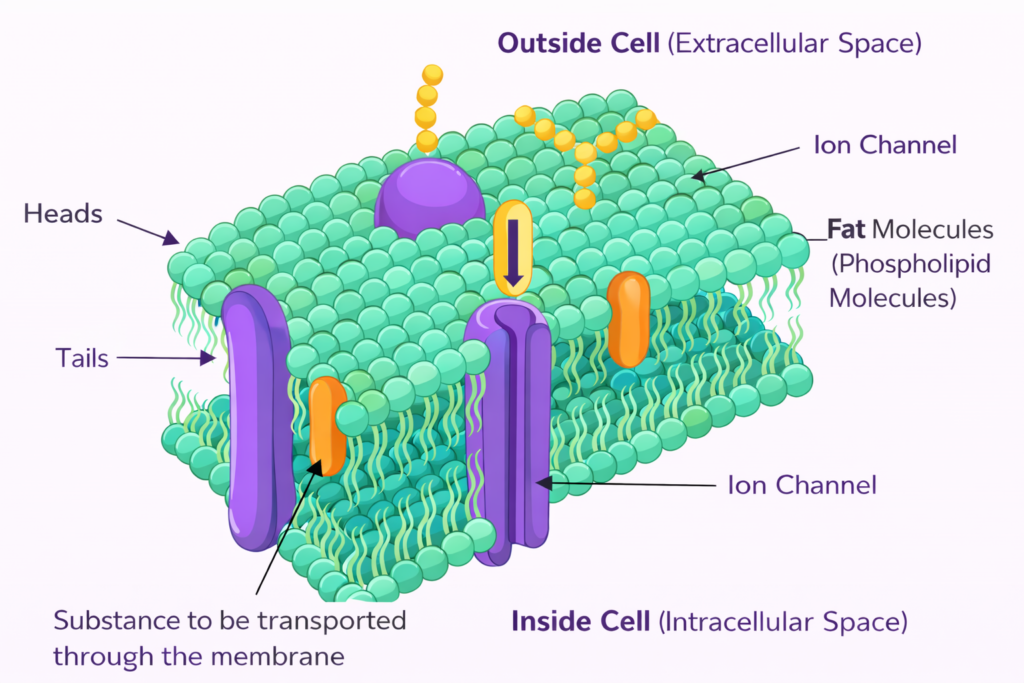
When I explain the cell membrane, I start with its basic function. The cell needs protection. But it also needs exchange. That’s why it develops a flexible boundary. This boundary can be kept tight and yet still controlled. That’s precisely what the cell membrane does.
I like to describe the membrane as a two-layered material made of fats and proteins. This combination seems simple. Yet it creates many possibilities. It stabilizes the cell’s interior. It allows selective transport. And it provides a platform for communication.
7.1 Lipid Bilayer: Why “Fatty” Is Brilliant Here
The membrane consists of phospholipids. These molecules have two important regions. One region attracts water. The other avoids water. Therefore, the molecules automatically arrange themselves into two layers. The water-attracting heads point outwards and inwards. The water-avoiding tails meet in the middle.
This creates a barrier. Water-soluble substances cannot easily pass through. This protects the cell. At the same time, the layer remains flexible. The molecules can shift laterally. This keeps the membrane elastic. This helps with pressure, tension, and changes in shape.
7.2 Channels, Pumps, Carriers: Proteins as Gatekeepers
Now the proteins come into play. I imagine these proteins as specialized door systems. Some proteins form channels. These channels allow certain particles to pass through. Other proteins act as carriers. They bind a molecule. Then they transport it to the other side. Still other proteins actively pump substances against a gradient. They use energy to do this.
Many membrane proteins also carry recognition structures. They bind hormones or signaling molecules. These then initiate signaling pathways inside the cell. This allows the cell to react in a targeted manner. Therefore, a membrane is not only sufficient for separation; it also controls behavior.________________________________________
________________________________________
8. Transport of Substances into the Cell: How Nutrients Get In and Waste Get Out
A cell can only survive if it exchanges substances. It needs nutrients. It needs water. It needs ions. At the same time, it must get rid of waste. Therefore, transport is not a secondary topic. It is fundamental to life.
I categorize transport into two main groups. First comes passive transport. Then comes active transport. Both principles complement each other. That’s why I use them together when explaining cellular processes.
8.1 Passive Transport: Diffusion, Osmosis, and Filtration
In passive transport, the cell utilizes existing differences in concentration. It saves energy. It allows substances to move along a gradient. This happens, for example, in diffusion. Particles move from high concentration to low concentration until an equilibrium is reached.
Osmosis describes a similar idea, but with water. Water moves through a semipermeable membrane. It moves to the side with the higher concentration of dissolved particles. This changes the pressure. That’s why osmosis plays a major role in many tissues.
Filtration depends more on pressure differences. Fluid and small particles are forced through a barrier. The body uses this principle, for example, in capillaries and the kidneys. That’s why filtration occurs not only in cells but also in organs.
8.2 Active Transport: When the Cell Has to Invest Energy
Sometimes a gradient isn’t enough. Then the cell wants to move substances deliberately against the flow direction. It uses energy to do this. It employs transport proteins that work like pumps. This allows it to build up concentrations. This allows it to maintain stable electrical voltages. And this allows it to control important processes.
I remember a simple logic: Passive transport follows physics. Active transport follows the cell’s goal. That’s why both are important.
8.3 Lock-and-Key Principle: Why Not Every Substance Can Pass Through Everywhere
Many carriers bind only to specific molecules. This is due to their shape and charge. The molecule only fits into the binding site if its properties match. This allows the cell to achieve high selectivity. It selectively absorbs nutrients and keeps problematic substances out. It also protects its internal structure.
This selectivity also explains why some medications work well and others don’t. The membrane plays a role. Therefore, transport is often a limiting factor.
9. The Cell Nucleus as Command Center: Genes, Control, and Identity
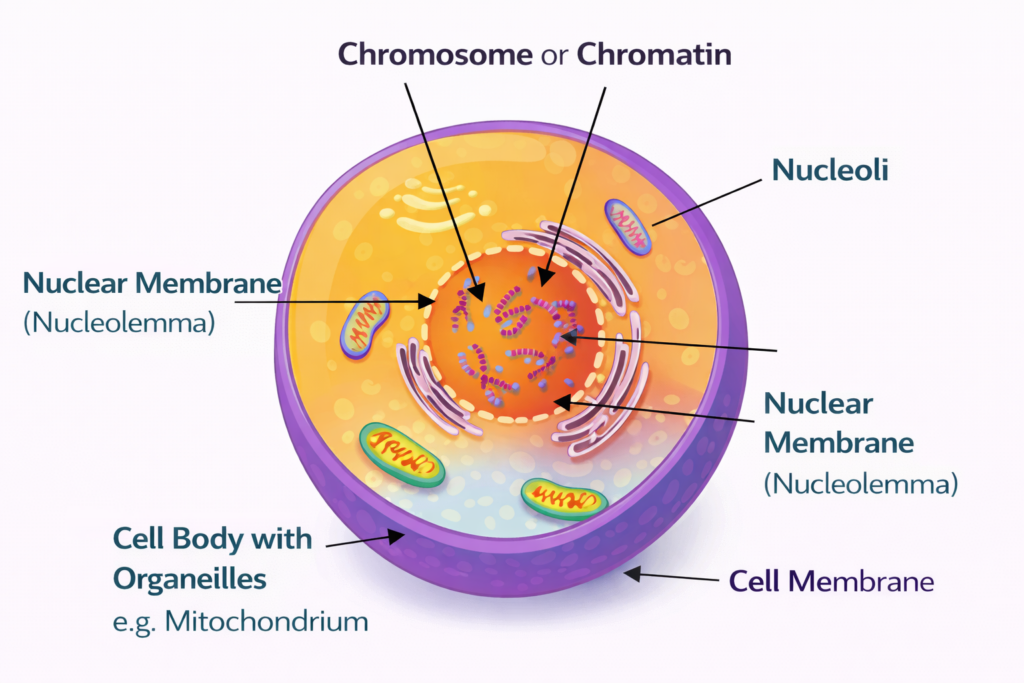
When I talk about control, I quickly arrive at the cell nucleus. This is where the genetic information resides. It describes which proteins a cell can produce. These proteins determine structure and function. Therefore, the cell nucleus is more than just a storage space.
I consider the cell nucleus to be the site of decision-making. It activates genes. It throttles genes. It reacts to signals from the cytoplasm. At the same time, it maintains the information so that it is preserved during cell division. This keeps the organism’s identity stable.
9.1 DNA and Chromosomes: Where Information is Stored
[BILD structureOfTheCellNucleus.png]
DNA carries the code. It is located in the cell nucleus in the form of chromosomes. I imagine chromosomes as structured packaging. The cell has to store a great deal of information in a small space. Therefore, it uses an intelligent organization.
This information describes, for example, enzymes, hormones, or structural proteins. It describes concrete building blocks. Nevertheless, it also provides control logic because it regulates when which building instructions are activated.
9.2 Chromatin: The Working Form of Genetic Information
Cells don’t always work with tightly packed chromosomes. They need access. Therefore, they loosen the material when they read genes. In this loosened form, I refer to it as chromatin. This form facilitates access to specific regions. This allows the cell to produce proteins in a targeted manner.
9.3 Why Every Body Cell Carries the Complete Blueprint
Many people assume that each cell only carries the part of the blueprint it needs. I take a different approach here. I explain: A typical body cell basically contains the entire blueprint. Nevertheless, it only actively uses a part of it. This is precisely what creates specialization.
A muscle cell reads different genes than a liver cell. Yet both possess the same initial information. Therefore, different cell types arise not from different DNA, but from different uses.
10. From Information to Protein: How Cells “Build” Proteins
Proteins are central to cell life. Enzymes accelerate reactions. Structural proteins give shape. Transport proteins move substances. Receptors receive signals. That’s why I ask early on: How does the cell get from information to protein?
I like to explain the process in clear stages. First, a copy of the information is created. Then, this copy travels to the production site. Finally, the protein is created from building blocks.
10.1 RNA as a Messenger: Information Leaves the Nucleus
The DNA remains well protected in the nucleus. The cell therefore works with copies. It creates RNA as a working copy of a selected section. This RNA carries the information out into the cytoplasm. This allows the nucleus to protect its data while still enabling production.
I therefore see RNA as a messenger molecule. It carries the blueprint to where the machinery is located. In this way, the cell separates storage and production. This increases security and order.
10.2 Nucleolus: Production Site of Important RNA Building Blocks
In the nucleus, I find one area that stands out. This area produces and organizes important RNA components for protein synthesis. In doing so, it supports the subsequent work in the cytoplasm. Furthermore, he shows me that even in the cell nucleus, active production processes are taking place.
When I explain the cell nucleus, I therefore don’t just call this area a detail. It’s part of the overall logic. The cell nucleus doesn’t just manage; it also prepares.
11. Cell Division Without Data Loss: How Cells Copy Themselves Correctly
The body is constantly replacing cells. Therefore, cell division must function reliably. I see cell division as the controlled copying of a complete system. The cell duplicates important contents for this purpose. It then distributes these contents to two new cells. This is how the organism remains stable.
I am deliberately sticking to the basics here. Because first I need the principle. Later, I can classify the individual phases in more detail.
11.1 Why Division Is Vital: Growth, Replacement, Repair
I recognize three main reasons for cell division.
- Growth. A body gets bigger because the number of cells increases.
- Replacement. Many cells age or break down. The body replaces them.
- Repair. Tissue heals because new cells fill the gaps.
Furthermore, cell division ensures long-term function. A cell cannot work indefinitely. It accumulates damage. It loses efficiency. Therefore, the body needs a strategy to provide fresh cells.
11.2 Spindle Apparatus and Centrioles: The Mechanics Behind Distribution
During cell division, the cell must distribute the genetic information cleanly. Otherwise, errors occur. To achieve this, it builds a kind of internal transport system. I call it the spindle apparatus. It grasps the chromosomes. It pulls them apart. And it ensures that each daughter cell receives a complete copy.
Centrioles play an organizational role in this process. They help build the structure for distribution. I imagine it as a starting point for a directed system. This creates order in a process that would otherwise appear chaotic.
12. The Cytoplasm as a Production Hall: Organelles at a Glance
When I “go inside” the cell, I don’t see empty fluid. I see a production hall. Structures are at work everywhere. Each structure takes on a subprocess. These structures are called organelles. I can think of them as specialized mini-organs inside the cell.
To get an overview, I use a simple question: What tasks does the cell have to perform? Then I assign the appropriate organelles. This creates a clear picture.
12.1 Organelles as “Specialized Departments” in Everyday Cell Life
A cell has to provide energy. It has to build proteins. It has to transport substances. It has to package products. And it has to break down waste. Organelles exist precisely for these purposes.
This helps me with learning. Because I don’t have to memorize every shape. I connect shape with function. This helps retain the knowledge.
12.2 The Organelle Map: Who Sits Where and Does What?
Many organelles work closely together. That’s why I see them as a network. For example: Ribosomes build proteins. The endoplasmic reticulum transports and processes them. The Golgi apparatus sorts and packages them. Vesicles carry the product to the membrane. This creates a logical production chain.
Furthermore, cell division ensures long-term function. A cell cannot work indefinitely. It accumulates damage. It loses efficiency. Therefore, the body needs a strategy to provide fresh cells.
The following image shows you all the important organelles at a glance:

- Mitochondria
- Ribosomes
- Smooth endoplasmic reticulum
- Rough endoplasmic reticulum
- Golgi apparatus
- Lysosomes
- Centriol
- Microtubules
13. Mitochondria: Generating, Storing, and Providing Energy
I call mitochondria the cell’s energy suppliers. They generate usable energy from nutrients. This allows the cell to function. Without this step, many processes would grind to a halt.
Mitochondria don’t just work in exceptional situations. They are constantly active. Even rest requires energy. A cell maintains stable concentrations. It repairs structures. It moves molecules. All of this requires energy.
Furthermore, a cell can adjust the number of its mitochondria. If a tissue needs more power, its capacity often increases as well. Therefore, mitochondria are a crucial factor in resilience.
14. Ribosomes: Protein Factories in Continuous Operation
Proteins determine function. Therefore, the cell needs a reliable production site. This production site is the ribosomes. I see ribosomes as machines that assemble amino acids in the correct sequence. The sequence comes from the RNA message.
Ribosomes are located freely in the cytoplasm or bound to membranes. Both variations perform tasks. Free ribosomes often produce proteins that remain within the cell. Bound ribosomes often produce proteins that the cell exports or incorporates into membranes. This creates order in the production flow.
Furthermore, ribosomes don’t work in isolation. They are connected to transport and processing systems. Therefore, the next step leads directly to the endoplasmic reticulum.
15. Endoplasmic Reticulum: Transport Network and Production Line
I imagine the endoplasmic reticulum, or ER for short, as an internal membrane network. This network extends throughout the cytoplasm. It connects different areas. It creates surfaces. And it organizes processes.
The ER exists in two main forms. Both forms differ in appearance. Therefore, they also differ in their function.
15.1 Rough ER: Protein Construction with Ribosomes
The rough ER has ribosomes on its surface. This gives it a granular appearance under a microscope. These ribosomes build proteins that often end up in membranes or are meant to be transported outside the cell. The rough ER helps to directly feed these proteins into an organized system.
I see it like a production line. The machine builds. The mesh receives the product. Then the next processing step begins. This saves the cell time. It also reduces errors.
15.2 Smooth ER: Transport and Transformation Processes
The smooth ER does not contain ribosomes. That’s why it appears smooth. This form supports other tasks. It helps with the transport of substances. It supports chemical transformations. And it participates in the production of certain classes of molecules that the cell needs.
Depending on the cell type, the body develops more of the smooth ER. Cells with high metabolic or transformation activity benefit particularly from it. Therefore, the smooth ER is an indicator of a cell’s “chemical work.”
16. Golgi Apparatus: Packaging, Sorting, Shipping
If I trace the path of a protein further, I arrive at the Golgi apparatus. I see it as the cell’s logistics center. It receives products from the endoplasmic reticulum (ER). Then it processes them. After that, it sorts them. And finally, it sends them to the right place.
The Golgi apparatus works like a multi-stage station. Each stage can modify proteins. This is important because many proteins only function correctly after this processing. Furthermore, the Golgi apparatus decides whether a protein stays in the cell or leaves it.
I imagine the process like this: The Golgi apparatus packs proteins into small vesicles. These vesicles move to the cell membrane. There, they release their contents to the outside or incorporate them into the membrane. This allows the cell to release secretions in a targeted manner. It can also add membrane proteins.
17. Lysosomes: Recycling, Degradation, and Defense
A cell doesn’t just produce; it also has to break down. Waste is constantly being generated, and foreign substances enter the cell. Sometimes, damaged structures need to be removed. This is precisely where lysosomes come into play.
I call lysosomes the cell’s recycling and degradation area. They contain enzymes. These enzymes break down proteins, fats, and other large molecules, creating smaller building blocks. The cell can often reuse these building blocks, thus conserving resources.
17.1 Enzymes as a Toolbox
Enzymes function like precise tools. Each enzyme is tailored to specific molecules. This allows the cell to degrade very precisely. At the same time, it protects itself by enclosing enzymes in lysosomes. This prevents aggressive reactions from running uncontrollably in the cytoplasm.
17.2 Why This Is Especially Important for Phagocytes
Lysosomes play a particularly important role in the immune system. Phagocytes engulf pathogens. Afterward, the ingested vesicles fuse with lysosomes. Then, enzymes break down the pathogen. This allows the cell to stop an infection directly at the cellular level.
I recognize a powerful principle here: Defense requires not only recognition but also breakdown. Lysosomes provide the necessary infrastructure for this.
18. Cytoskeleton and Microtubules: Stability and Internal “Delivery Service”
A cell appears soft. Nevertheless, it needs structure. It needs shape. And it needs internal transport. It uses a cytoskeleton precisely for this purpose. This cytoskeleton consists of various types of fibers. One important type of fiber is microtubules.
I imagine microtubules as tubes inside the cell. They provide stability. At the same time, they act as tracks. On these tracks, the cell transports vesicles and organelles to the correct location. This creates order within the cell.
18.1 Giving Shape and Maintaining Structure
Without a cytoskeleton, a cell would quickly lose its shape under stress. That would be problematic. Many cell functions depend on shape. A muscle cell needs a specific orientation. A nerve cell needs long processes. An immune cell must be able to deform quickly. The cytoskeleton supports these requirements.
18.2 Intracellular Transport, Especially Important in Nerve Cells
Transport becomes particularly relevant when distances increase. This is precisely what happens in nerve cells. There, the nucleus and production sites are often located in the cell body. At the same time, target areas are located far away in the processes. Microtubules help transport material there. This keeps the nerve cell functional.
Therefore, I remember: Microtubules are structure and transport in one. That’s what makes them so important.
19. Special Case: Nerve Cell: Why Cells Can Become “Meters Long”
Nerve cells exhibit a special characteristic that surprises many. They can form extremely long processes. These processes connect distant areas in the body. This enables rapid communication over large distances.
I explain it to myself like this: The body needs speed. But it also needs precision. A signal should arrive in milliseconds. That’s why it uses electrical impulses. And that’s why it uses cells that form conductive pathways.
The cell body handles control and production. The long extensions take over conduction. This acts like a division of labor within a single cell. As a result, the form perfectly matches the function.
Furthermore, this special case demonstrates something fundamental: cells adapt. They use the same basic blueprint. Nevertheless, they massively modify it depending on the task. This is precisely what makes cell biology so fascinating.
20. The Immune System at the Cellular Level: Eating or Marking?
When it comes to the immune system, I like to look at its strategies. The immune system solves a clear problem: it must recognize and eliminate foreign substances. It uses various methods to do this. Two key methods are direct elimination and indirect marking.
20.1 Phagocytosis: Capturing and Breaking Down Invaders
In phagocytosis, a phagocytic cell engulfs the invading substance. It pulls it into the cell. Then it breaks it down, often with the help of lysosomes. This eliminates the pathogen. At the same time, fragments are produced that the immune system can further process.
I find this strategy particularly effective because it acts quickly. It stops local problems right at the site of the outbreak.
20.2 Antibodies: Marking and Neutralizing Pathogens
Sometimes simply consuming isn’t enough. In these cases, the immune system uses marking. Antibodies bind to the surface of a pathogen. This marks it as foreign. They can also block important surface sites. This helps because many viruses or bacteria need specific docking sites to infect cells.
In addition, a marker often attracts other immune cells. These immune cells recognize the marked pathogen more easily. This makes elimination faster and more coordinated.
I summarize it for myself like this: The body attacks directly when it can. And it marks when it needs teamwork. Both strategies complement each other.
21. When Cell Processes Get Out of Rhythm: What Happens Then
Cells work precisely. Nevertheless, disruptions occur. Sometimes energy is lacking. Sometimes transport is blocked. Sometimes the immune system reacts too strongly or too weakly. And sometimes errors occur during cell division. I don’t see such disruptions as isolated incidents. I see them as consequences of a disrupted fundamental principle.
That’s why a simple approach helps me: I first examine supply, transport, regulation, and breakdown. These four areas determine the cell’s daily routine. If something goes wrong here, the entire tissue often suffers.
21.1 Inflammation as a Coordinated Cellular Response
From the outside, inflammation often appears to be a problem. Nevertheless, it starts as a protective program. Cells in the tissue send signals. Blood vessels react. Immune cells migrate in. Then they fight off triggers like bacteria or viruses. At the same time, they clear away cellular debris.
I pay particular attention to the movement of immune cells. They leave blood vessels. They follow chemical trails. And they concentrate at the site of the disturbance. This creates a local immune front. Blood flow often increases there as well. This leads to heat and redness. Then fluid accumulates in the tissue. This leads to swelling. And nerves become more sensitive. This leads to pain.
I see a clear logic in this. The body brings resources to the site of danger. Nevertheless, the system can overreact. Then inflammation damages the body’s own tissue. That’s why balance is crucial.
21.2 Why Detoxification and Transport Mechanisms Are Crucial
Many cellular problems don’t begin with a pathogen, but with metabolic stress. If remodeling processes don’t run smoothly, intermediate products accumulate. If transport doesn’t function properly, substances build up. If breakdown slows down, damaged structures accumulate.
The liver plays a central role here. It modifies substances so the body can eliminate them. At the same time, cells depend on functioning membranes. Membranes control uptake and release. Therefore, membrane proteins and transport pathways influence many health processes.
I’m deliberately putting it simply: If substances can’t get in or out, every cell suffers. And when cells suffer, the organ suffers.
22. Memorize instead of memorizing: A simple checklist for cell structure
I learn cell biology best with set questions. This allows me to recall information even if details are missing. Here is my checklist. It works for almost any standard cell.
Checklist: How to check a cell in 60 seconds
- Boundary: Which membrane separates the inside from the outside? Which transport proteins are located there?
- 2. Control: Where is the nucleus located? What role does genetic information play in this cell?
- Energy: How many mitochondria does the cell need? What is its energy requirement?
- Protein production: What role do ribosomes and rough ER play?
- Packaging and shipping: How active is the Golgi apparatus? Does the cell produce secretions?
- Degradation: How important are lysosomes? Does the cell have to recycle a lot or break down pathogens?
- Shape and transport: How well-developed is the cytoskeleton? Do microtubules use a long transport route?
- Specialization: What is the cell’s main function in tissue?
This list allows me to quickly categorize almost any chart. It also makes it easier for me to understand new cell types. Therefore, I save time when studying.
24. Conclusion: The Cell as the Foundation of Body, Health, and Performance
I understand the human body better when I start with the cell. The cell provides the basic blueprint for everything that later becomes visible as organ function. It defines its boundaries. It absorbs substances. It generates energy. It builds proteins. It packages products. And it recycles waste.
At the same time, the cell shows me how specialization works. Many cell types share the same nuclear structure. Yet they use it for completely different tasks. This is precisely why the body can remain stable and still react flexibly.
If I remember the membrane, nucleus, and organelles as a cohesive system, then biology becomes easier for me. Furthermore, I can better understand many topics related to health, training, and medicine. That’s why this look into the microcosm is worthwhile.
FAQ: Frequently Asked Questions about the Human Cell
What makes a cell the smallest unit of life?
A cell organizes its own metabolism, energy, and response to signals. It can also divide when conditions are right. Therefore, it can function as an independent living unit.
Do all body cells have a nucleus?
Many body cells have a nucleus. There are some exceptions. Certain cells shed their nucleus during maturation. This frees up space for their specialized function.
Why does every cell look different, even though the basic structure is similar?
The basic structure remains similar. Nevertheless, the cell adapts to its function. It changes its shape, organelle composition, and membrane proteins. This is how specialization occurs.
What do cell membrane proteins do?
Membrane proteins control transport and communication. They selectively allow substances to enter or exit the cell. They also receive signals such as hormones. This allows the cell to react and adapt.
Why are mitochondria so important?
Mitochondria provide usable energy. This energy powers transport, synthesis, and movement. Without sufficient energy, cells quickly lose performance and stability.